Both liquid and powder detergent get clothes clean, but they don't behave the same way once they hit UAE tap water. If you're choosing between them — or wondering why a switch from one to the other changed how your laundry turns out — the short answer is that liquid tends to be the more forgiving, more consistent choice in hard water and cooler wash cycles, while powder still has its place for certain stain types and budgets.
What's actually different between them
Powder detergent is a dry blend of surfactants, builders, and (often) bleach-based whitening agents. It has to fully dissolve in the wash water before it can start working — which is easy in a hot, well-agitated cycle, and much less reliable in a cold or lukewarm one. Liquid detergent is already dissolved. There's no dissolving step to fail, so it starts working the moment it hits the water, at any temperature.
Why the difference matters more in UAE conditions
Two things about washing laundry in the UAE make this gap wider than it would be somewhere with softer water and a colder climate:
- Hard water. UAE tap water carries more dissolved minerals than the water most detergents (imported or otherwise) are calibrated for. Undissolved powder can bind with those minerals before it ever reaches your clothes, sometimes leaving faint white residue on dark fabric.
- Cold-wash habits. Many households wash on cold to save on electricity and protect fabric — which is exactly the condition powder struggles to fully dissolve in. Liquid doesn't have that dependency.
That faint dusty film sometimes left on dark clothes after washing isn't usually a sign of a weak formula — it's often undissolved powder that never fully broke down in the wash. Switching to a liquid formula removes that failure point entirely, since there's nothing left to dissolve.
| Factor | Liquid | Powder |
|---|---|---|
| Cold water performance | Consistent | Can leave residue |
| Hard water performance | More reliable | More prone to mineral binding |
| Stain pre-treating | Apply directly | Needs a paste first |
| Dosing precision | Measuring cap, easy to control | Scoop-based, easier to over/under-dose |
| Cost per kg | Often higher | Often lower |
Where powder still holds its own
Powder isn't obsolete. On ground-in dirt and mud — where the bleach-based whitening agents many powders include give them a genuine edge — and on a pure cost-per-kilogram basis, powder can still be the more practical pick, particularly for hot-cycle washing where full dissolving isn't a concern.
Closing the cost gap with a concentrated liquid
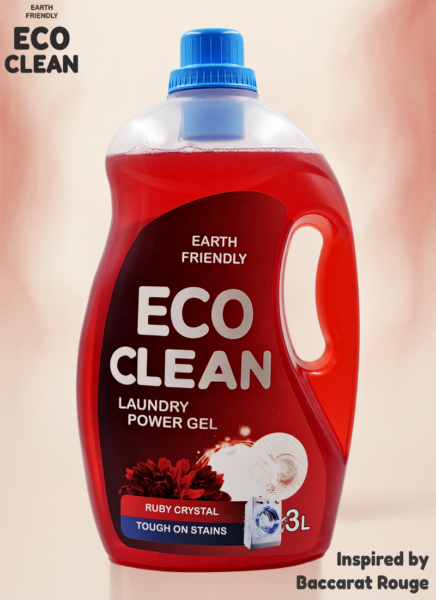
The "liquid costs more" argument mostly holds for standard, diluted liquid detergents — where you're paying more per wash for a formula that's mostly water. A genuinely concentrated liquid changes that math: Ruby Crystal Power Gel delivers up to 42 washes from a single 3-litre bottle at the recommended 30ml dose, which puts the real cost-per-wash much closer to powder than a standard liquid detergent would be — while keeping liquid's hard-water and cold-wash consistency.
So which one should you use?
If most of your washing is on cold or warm cycles — which covers most UAE households most of the year — a concentrated liquid detergent is the more consistent choice, with no dissolving step to fail in hard water. If you regularly run hot washes on heavily soiled loads and want the lowest possible cost per kilogram, powder still earns its place in the cupboard. Plenty of households end up using both: liquid for everyday loads, powder reserved for the occasional deep-clean hot wash.
Want to see the full range built around UAE hard water and cold-wash habits? Browse our laundry care products for UAE homes, including the concentrated Power Gel and matching fabric softener.
Frequently asked questions
Liquid generally performs more consistently in UAE hard water, since it's already dissolved and won't leave the mineral-bound residue powder can leave behind in cold or lukewarm washes.
It can, particularly in cold water or hard water, where undissolved powder granules bind with minerals instead of fully dissolving — showing up as faint white marks on dark fabric.
Powder is often cheaper per kilogram, but a concentrated liquid formula can close that gap significantly on a genuine cost-per-wash basis — for example, up to 42 washes from a single 3-litre bottle.
Yes — liquid detergent can be worked directly into a stain before washing, giving the surfactants a head start. Powder needs to be dissolved into a paste first to do the same job.